Our extensive inventory includes a wide range of products from renowned brands, ensuring that you find the perfect equipment to elevate your listening experience.
Reed Tonearms

Reed 5A
Reed 5A tonearm introduced as angling- 90o -tangential-pivot-tonearm, it is based on Double Birch/Thales geometry and will complement our tangential tonearm lineup.
Below is the scheme of Double Birch/Thales geometry ( Fig.1). Tonearm geometry is optimized for minimal tracking error.
Operating principle of the tonearm is illustrated in:
https://www.youtube.com/watch?v=oIoHvCE9F0I
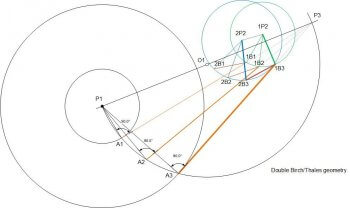
Fig. 1
P1, O1, P3 – Thales’ semicircle,
P1-A1-P3, P1-A2-P3, P1-A3-P3 angles are 90⁰ each,
A1,1B1 = A2,1B2= A3,1B3 segments represent tonearm length,
1B – vertical axis of the tonearm,
1P2 – center of the circle, which is drawn through three points -1B1,1B2,1B3,- axis of rotation of the back link component
2P2 – center of the circle, which is drawn through three points -2B1,2B2,2B3,- axis of rotation of the front link component
1B1,2B1 = 1B2,2B2 = 1B3,2B3 – tonearm lever.
Armtube suspension system is similar to the one used in Reed 3P tonearm.
Tonearm’s back link uses low-noise ceramic rolling bearings.
Lever uses low-noise ceramic rolling bearing and rests on the sapphire – molybdenum carbide thrust bearing.
Sapphire – molybdenum carbide thrust bearings are also used for tonearm’s front link, vertical and horizontal axes.
Tonearm has VTA and azimuth setup and can be configured with Reed or SME (universal headshell connector) headshells.
To make sure tonearm setup is precisely horizontal, tonearm has integrated level and horizontal plane adjuster.
Comparing to regular pivot tonearms, Reed 5A does not require antiskating and has much less absolute tracking error (max. tracking error is +/- 4 Minute of Angle (MOA) (Fig.2). Pivot tonearms – approx. 1.2 – 2.5 deg. (Fig.3).
Comparing to other tangential tonearms, Reed 5A does not require any additional devices to work (e.g. compressors, electronic controllers), is compact and can be easily mounted on a wide range of turntables.
Reed Tonearms

Reed 1H
Reed 1H is the latest addition to our entry level tonearm series. And, for the first time, we introduce carbon fiber as primary Reed 1H’s armwand material.
After a thorough research we found a way to make the carbon fiber armwand’s acoustic properties close to ones that normally are typical for the wood.
By using soft wood to damp the carbon fiber tube, our new armwand’s acoustic properties become considerably better than using carbon fiber alone, and can be compared to wooden armwands.
Differences between acoustical properties of damped and undamped carbon fiber wand are shown in Figures 1 and 2.
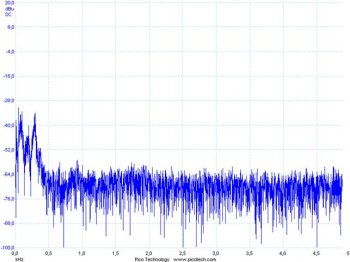
Figure 1. Damped carbon fiber.
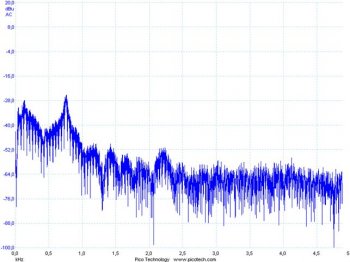
Figure 2. Carbon fiber.
Reed 1H has a cardanic bearing system: vertical axis has thrust rotation bearings and horizontal axis is based on thrust pivot bearings (same concept as in Reed 3P). Such bearing construction eliminates wobbling of a bearing, which has a great impact on the quality of the sound.
Among other features, Reed 1H tonearm has azimuth adjustment, replaceable headshell and VTA adjustment. Tonearm height adjustment range is from 28mm to 48 mm. It is also easily tuned and can be mounted on most turntables out of the box or using an adapter.
Tonearm signal output is either 5 pin-DIN connector or Finewire 37 cables.
Antiskating: magnetic, similar to the one used in Reed 3P.

Reed Tonearms
.jpg)
Reed 2B
Our newest tonearm Reed 2B offers our users three new operating possibilities:
1) A possibility to use heavier cartridges, up to 35 grams. The low-friction, ceramic bearings are used in this tonearm;
2) Tonearm “2B” comes fully assembled; it is only needed to mount the tonearm and adjust settings like VTA, VTF, azimuth and anti-skating;
3) The anti-skating force can be easily changed independently at the beginning and end of the record. This feature is practical for all newer cartridges’ users, exceptionally because of a variety of the new cartridge’s stylus’ shapes causing different friction forces between the stylus and record groove.
Short theory.
As we already know, when a stylus rides in a groove, the friction force provides a forward force which is tangential to the record groove. (Fig.1. Anti-skating)
F = μN μ – coefficient of friction, N – stylus force (VTF).
Whereas the direction of this force F is displaced 90°+ α from the line between the pivot and the stylus O2-A, this force provides a clockwise moment M around the pivots O2 (Fig.1. Anti-skating), which tends to drag the stylus towards the spindle O1.
In case to avoid the force imbalance while the stylus bears against the inner groove wall, moment M should be eliminated completely at any position on the record. This moment can be expressed by the following equation:
While the F, L and D are constant factors, and R varies accordingly to the stylus’ position, moment M can be expressed as a function of R (Fig.2 Theoretical). Practically an experiment was executed to determine skating force at different points of a record. Instruments used for this test were: fully matte and smooth test vinyl and tonearm Reed 3P with a “Phasemation PP-2000MC” cartridge that was subjected to 1.9 grams vertical tracking force during testing (Fig 3. Practical). Differences in skating force are clearly noticeable at the beginning, middle and end of the record.
Theoretically, it is known that moment M can be eliminated by providing equal compensation in the opposite direction (-M). (Fig.1.). In most cases, M is applied as a constant force, therefore the side thrust is completely eliminated only at a few positions on the record. To conclude, a tonearm with adjustable anti-skating force depending on the position on the record (diameter) is highly demanded.
Tonearm “Reed 2B” has the possibility to control anti-skating force by adjusting two anti-skating regulation handles at any time while playing a record.
My Sonic Lab
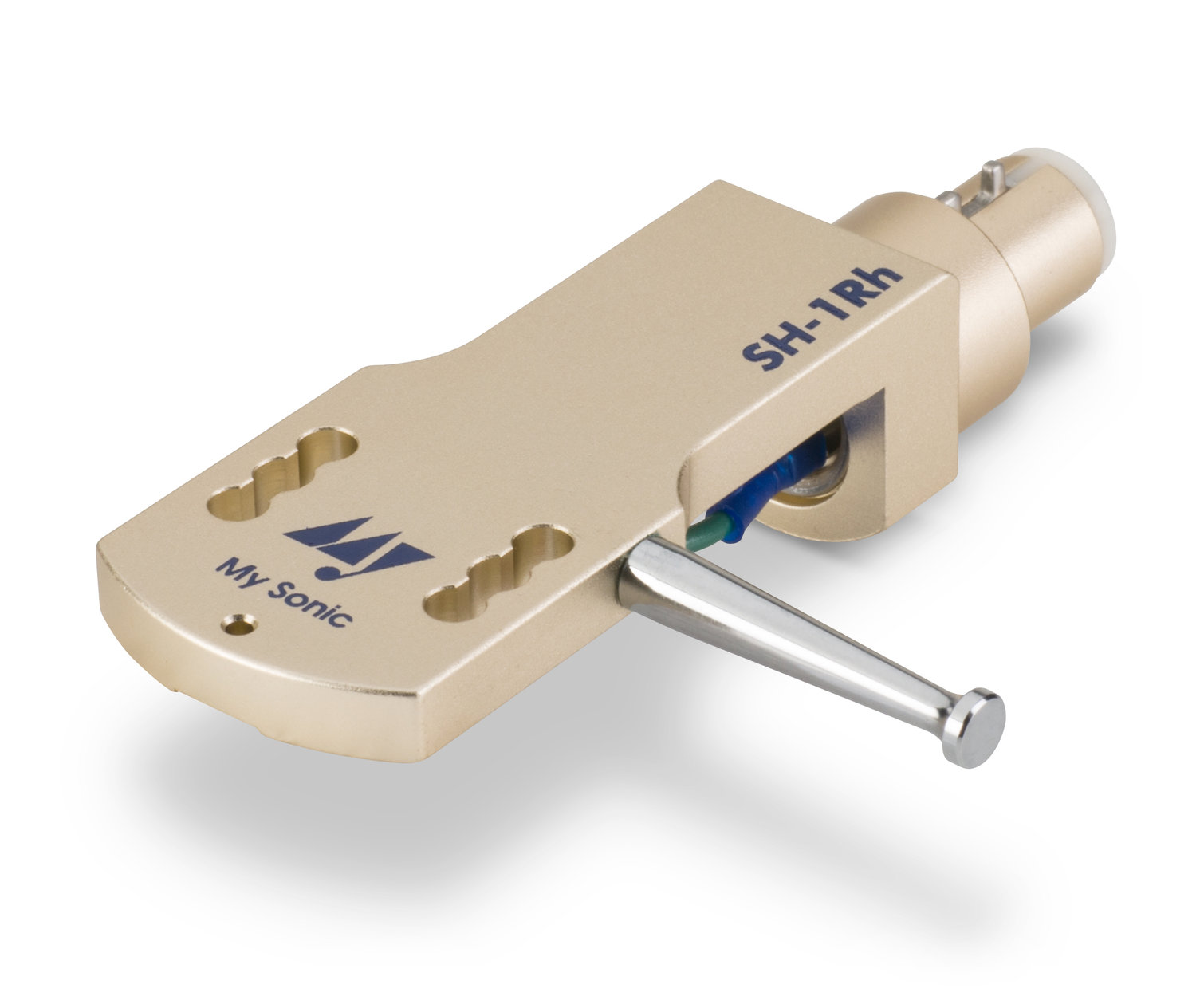
SH-1rh
The My Sonic Lab SH-1RH headshell was developed with an emphasis on sound quality. This high-grade design is made using hard anodized aluminum alloy (A6063S) with excellent strength to support any cartridge you choose and keep unwanted resonances at bay. Moreover, the mounting holes are fixed positions with 3-points placed at +/- 3 mm intervals from the center. This design pattern completely holds the cartridge in place and makes cartridge mounting and overhang alignment extremely simple. The headshell connector is a highly reliable design that introduces a twin key lock system that completely locks the headshell into your tonearm. In addition, expensive bright rhodium plating treatment containing trace amounts of platium ore and gold ore is used for its excellent sound quality and reliability for each part of the terminal pin and terminal connector.
Each package includes one SH-1RH headshell and cartridge mounting hardware.
My Sonic Lab

Eminent Ex
The sound of the Eminent Ex is the result of master cartridge designer Yoshio Matsudaira seeking natural reproduction by minimizing signal loss, internal distortion, and phase distortion. Eminent EX utilizes Matsudaira-san’s unique SH-μX magnetic core. This special core material has higher permeability and flux density than the core material typically used in MC cartridges. It allows My Sonic Lab to use fewer coil windings than other moving coil cartridges, minimizing music robbing distortions, while not making the sacrifice of signal output. This high efficiency approach equals wide dynamic range, fast transient response, low distortion and high signal-to-noise ratio. In other words, expect tremendous natural detail and clarity and to hear new layers of information in your favorite records.
"My Sonic Lab's Eminent EX is among the finest, most skillfully balanced cartridges I've heard." —Michael Fremer, Stereophile
"If Mercury Records had designed a cartridge that captured the Living Presence sound, it would have been the My Sonic Labs. From the moment the needle hits the groove, things sound 'alive!' Not only does this playback device have more zap and dynamics, it also has a more liquid sound, and is so genuinely seductive you might well buy it on first listen." —Harry Pearson, The Absolute Sound
My Sonic Lab

Hyper Eminent EX
The Hyper Eminent EX cartridge is made from super hard A7075 aluminum with strengthening measures achieved with an ion surface hardening treatment. This treatment creates a sandwiching effect and eliminates the inherent resonances of a single material. The result is a 10x harder surface than the body of Eminent EX.
This extra hard body, combined with the warm and natural sound of the Super Duralumin cantilever, makes the Hyper Eminent detailed but never lean sounding.
My Sonic Lab

Ultra Eminent EX
This Ultra Eminent EX resides in the middle of the My Sonic Lab family. Compared to the standard Eminent EX and Hyper Eminent, the Ultra has much lower internal impedance (and output) and a boron cantilever. The result of these improvements are lightning fast transient response and pinpoint precise sound staging. Ultra Eminent EX reproduces complex music with ease and master tape sound quality.
“… the Ultra Eminent Ex's presentation sounded like analog tape. I believe this was caused by extreme amounts of low-level detail. The (Ultra) Eminent Ex retrieved so much microdetail that I swore I could hear right through the grooves to the analog tape passing across the recorder's playback head.” -Herb Reichert, Stereophile
