Our extensive inventory includes a wide range of products from renowned brands, ensuring that you find the perfect equipment to elevate your listening experience.
Analog Relax
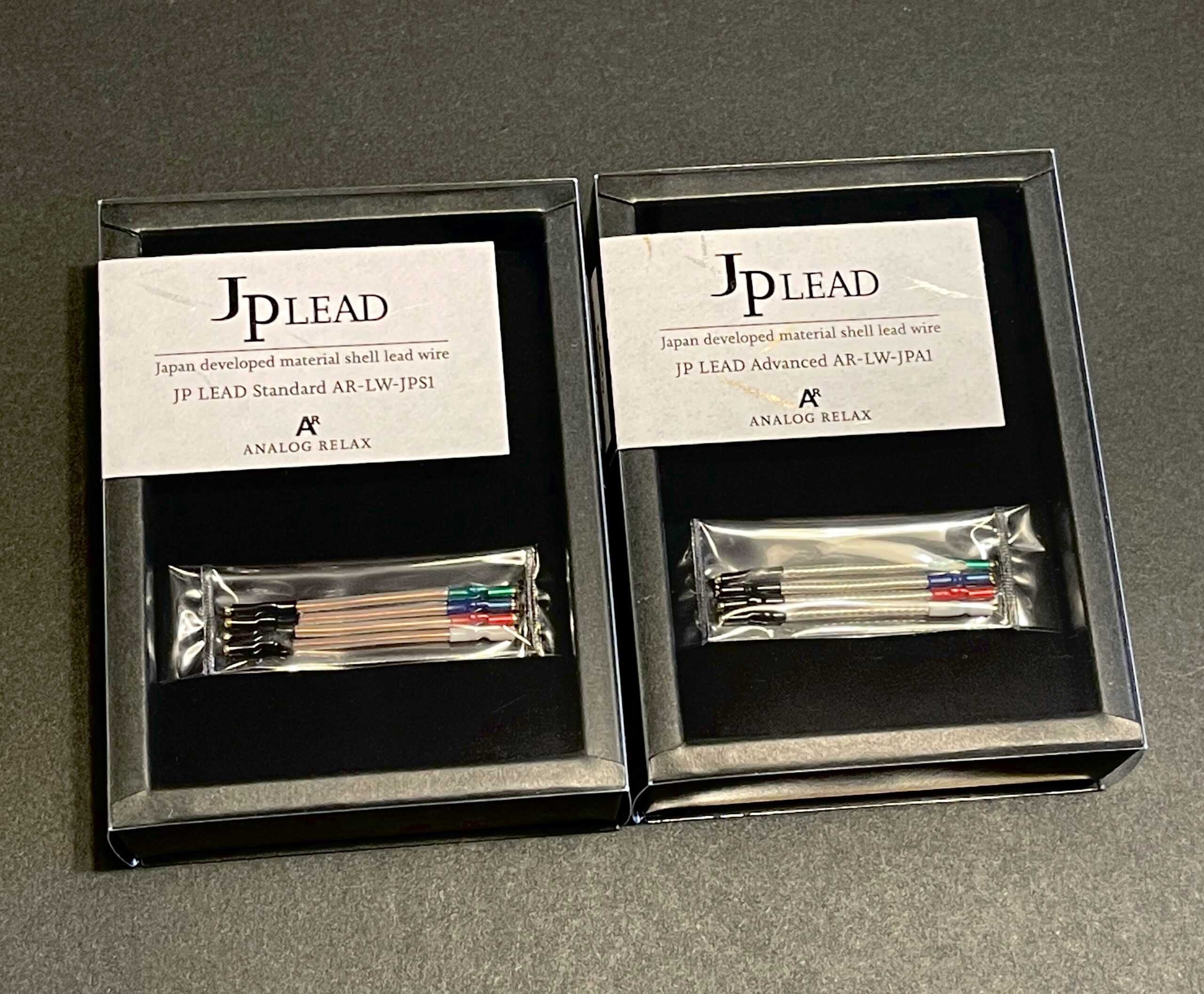
JP Lead Wire
The JP LEAD was developed for shell lead wires. It utilizses cable made of the most advanced materials that have been invented in Japan.
This cutting-edge item breaks conventional wisdom.
This excellent product is made for enthusiasts who are passionate about audio.
Cables invented in Japan
The JP LEAD uses two state-of-the-art cables, both of which were invented in Japan.
-PC Triple C: OFC copper wire manufactured using proprietary forging methods that remove micron-sized impurities. It is even purer than PCOCC.
-PC Triple C/EX: The surface of the PC Triple C is coated with a dual-layered 5N pure silver structure. The high-frequency band passes through the silver, allowing for wider bandwidth transmission.
There are two items in the product lineup
-JP LEAD Standard AR-LW-JPS1: Made with PCTripleC cables, which were invented in Japan, and domestic silver soldering. Experience a wider range through a next generation conductor with specifications that exceed PCOCC.
-JP LEAD Advance AR-LW-JPA1: Made with PCTripleC/EX cable, which is PCTripleC coated with 5N pure silver. High conductivity for even greater dynamic range and shine
Analog Relax
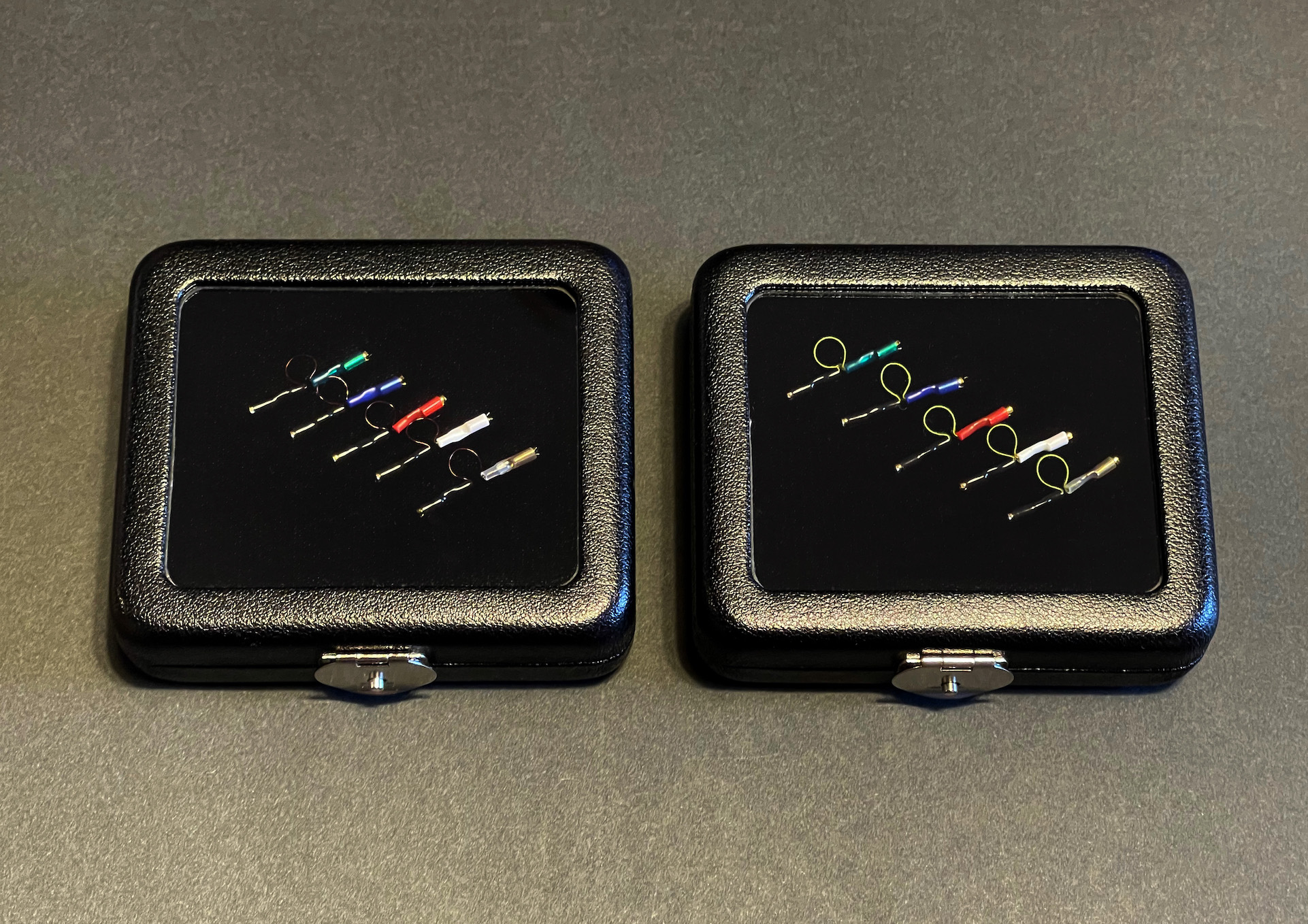
Emotional Lead Wire
Bringing you sounds that move the heart
When you listen to records, what do you listen to?
Do you just listen to sounds? Or do you listen to the music carved onto your records?
We are here to help you to enjoy and be moved by the music on your records.
The EMOTIONAL LEAD is a sublime shell lead wire that will provide a mind-blowing experience, releasing the likes of which you’ve never heard from your records.
Thorough wire polishing technology
EMOTIONAL LEAD was created using thorough polishing techniques. The wire surface, where solder is applied, is processed to a mirror finish using a variety of polishing techniques to match material of the wire, pushing the surface to the limit. The layer of solder alloy is controlled to ideal proportions to achieve the intended sound. Tamahagane blades, which were used for Japanese swords, are used for the polishing.
Analog Relax
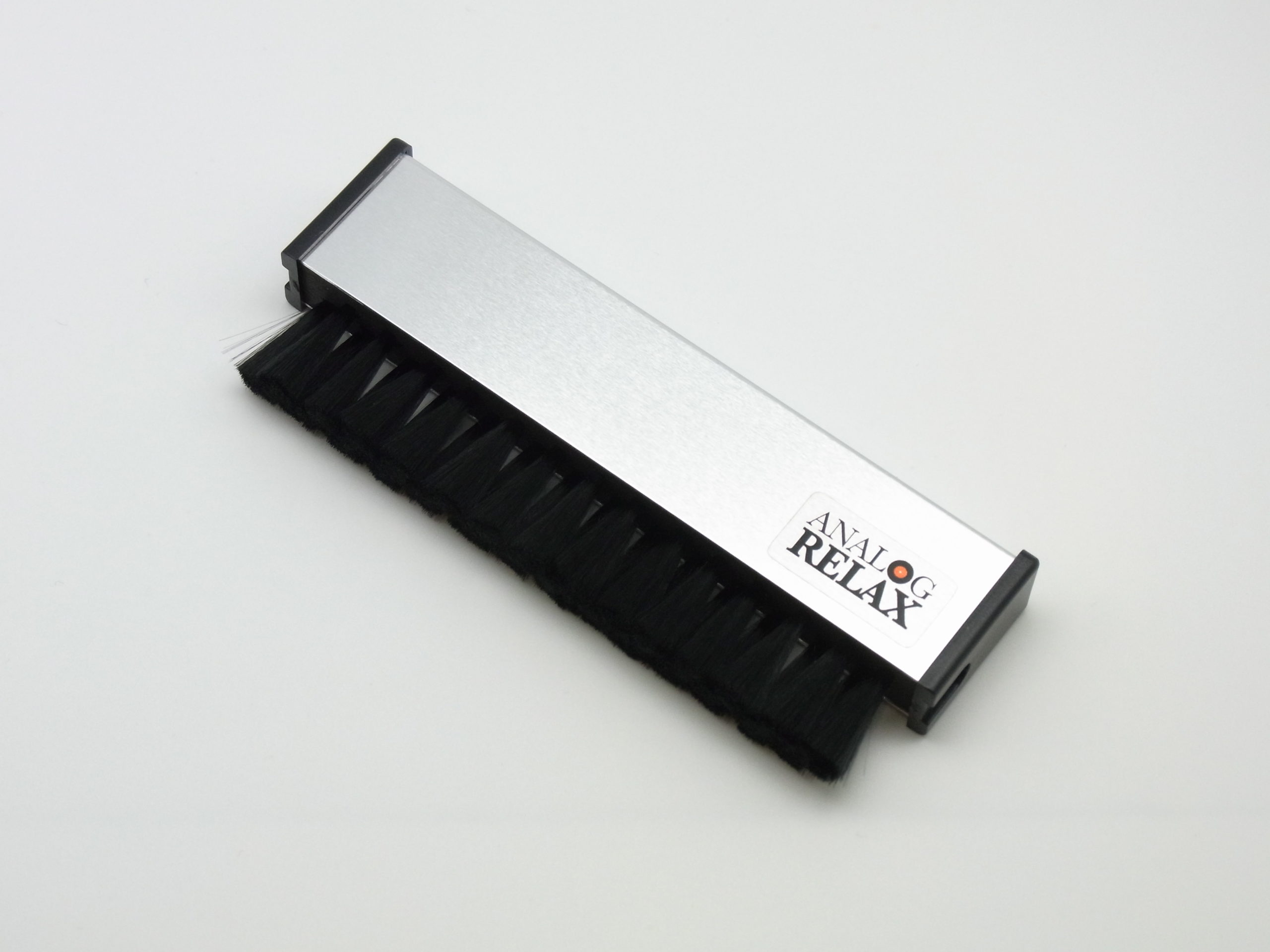
Anti-Static Brush
Irritated by the disturbing static dusts on your record? Want to be free from the problem?
The only answer to save you from the curse of static dusts
Only Analog Relax anti-static brush can remove static electricity and dusts at the same time together.
Ultra-fine static elimination fiber with 0.03mm in diameter, special material used for an audio product for the first time in the world, comes in the record groove removing static and dust all together.
You will be liberated from the frustration of static dusts with this revolutionary record brush. This brush makes all the record lovers happy.
Did you know the fact?
Did you know that a record could collect 3,000~20,000V static electricity on its surface when it is taken out of the sleeve? The move of just taking out of the sleeve could generate such amount of static. This is because of the friction between the disc and the inner sleeve when they are pulled apart.
The static electricity collects all the dust floating around you to your disc surface. The dusts attached to the disc are real pain. If you wipe them off, they just come back on the record immediately.
Why? Because of the static electricity. You cannot be free from the dust unless you are free from the static.
Record lovers have confronted the static dusts and struggled for a long time. Maybe at this right moment, many of them must be in the middle of this struggle.
This is for you.
The brush quickly discharges static electricity and removes dusts at the same time.
This is Analog Relax anti-static brush, created specially for vinyl discs.
Annoyed at such problems as below?
Usual velvet pad record cleaners generate static every time they are used, only to attract the dusts back to the record again.
Cleaning sprays are also in the market, but you don’t want to put unnecessary chemical on your precious discs.
Liquid cleanser is too much trouble. Wash all the record library? No way!
Your record clicks and pops on the turntable due to the static especially in the dried wintertime.
This brush clears away the irritating static dusts that disturb you every time you play the record.
How your record gets charged on the surface just by removing the sleeve?
Static electricity is generated in various ways and mechanisms, but you see two types in using audio systems; peeling and frictional.
Peeling electrification: electricity is charged on the surfaces of two objects that are touching to each other when they are pulled apart. That is the same for a record disc pulled out from the inner sleeve.
Frictional electrification: This occurs when two objects are rubbed against each other. Same for the contact between a record and a brush or a stylus tip
Thus you generate static electricity every time you take your record out of the sleeve.
The amount of charge is as high as 3,000 ~ 20,000V depending on the environment (temperature and humidity).
The lower the humidity is, the higher the charge tends to be.
Analog Relax anti-static brush was created in order to eliminate…
Static charge of the record just taken out of the sleeve.
Static charge after playing the record on the turntable.
Analog Relax anti-static brush can remove 70 ~ 80% of static electricity on average though depending on the room environment and the timing of the vinyl disc production.
Analog Relax
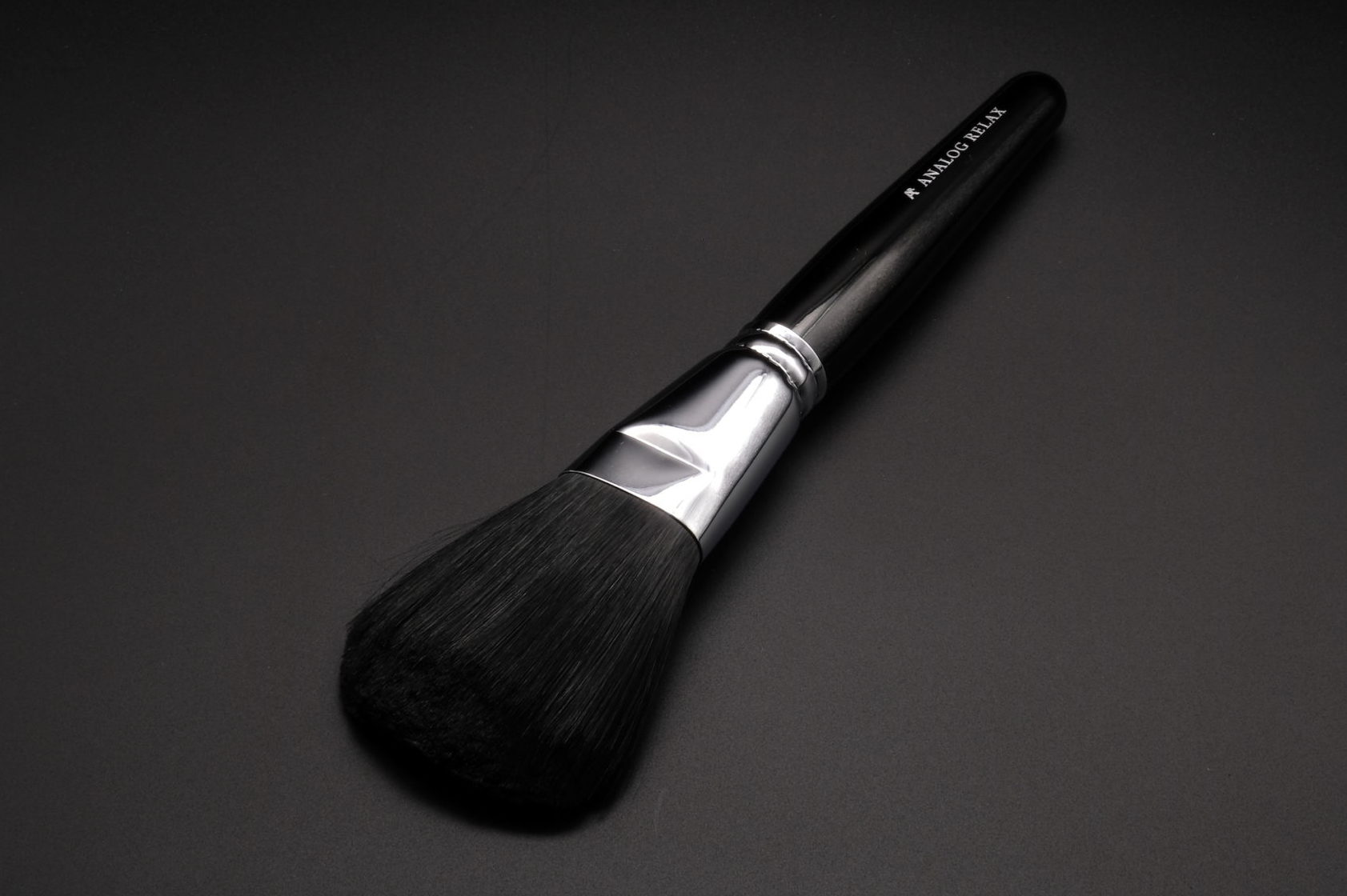
Anti-Static Brush for Audio Equipment
The world’s first antistatic brush made exclusively for audio equipment, made with ultra fine “static neutralizing” fibers with a 0.03 diameter for the finest quality of softness, assembled at the hands of Kumano Brush craftsmen.
At some point, dust tends to accumulate in places like on the top and front of tone arms and amplifiers. How frustrating is it when, no matter how well you clean, there are some hard to reach places you just cannot get to, right?
In this way, I used to be someone that felt that too.
This dust is actually drawn there by the electrostatic charge in your audio equipment.
You are probably aware of this already, but audio equipment runs on electricity, and has moving parts such as tone arms, turntables, and CD trays.
For that reason, audio equipment is destined to be electrostatically charged, as it constantly produces its own static electricity.
Normally, there’s a mechanism in place to ground static electricity from a power supply. Unfortunately, in many cases, besides a small portion of refrigerators and washings machines within the common household, audio equipment will be continuously electrostatically charged as they are often not fully grounded.
As a result, not only does the static electricity cause dust to accumulate, but the electrostatic charge will cause your audio equipment to be unable to demonstrate its true capabilities. A phenomenon then occurs where you will continue to listen to your audio in a state of reduced sound quality.
In this way, your audio equipment will remain constantly affected by this electrostatic charge unbeknownst to you.
You should rid your equipment of static electricity as soon as possible!
The “Analog Relax Anti-Static Brush for Audio Equipment” will effectively remove any electrostatic charge from your audio equipment and brush out any accumulated dust.
The “Analog Relax Anti-Static Brush AR-ASRB1” was specially tailored for ease of use to clean audio equipment, and has also been well received for its use on vinyl records.
(Although it is labeled “for audio equipment,” you can also certainly use it for “software” such as vinyl records and CDs.)
The production of this brush was entrusted to the “Kumano Brush” craftsmen, famously known for their luxury cosmetic brushes in Japan.
Along with the finest quality of softness and the perfect R (curved surface) made by the tip of the brush hairs, the finishing touches of this product make it incredibly easy to work with.
Do not delay and remove the electrostatic charge and dust from your audio equipment with certainty using this brush.
And restore the original capabilities and sound quality of your beloved equipment.
Analog Relax
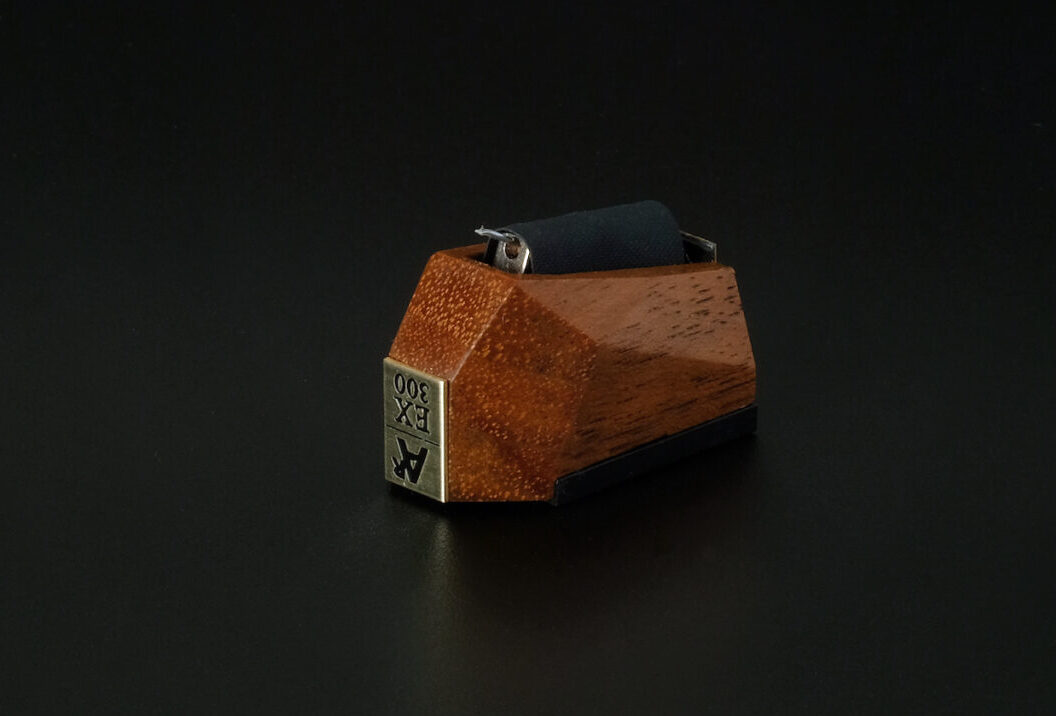
EX300 Phono Cartridge
EX300 adapted newly developed “IF adhesive” technology for stronger integration of the stylus and cantilever, also the body housing consists of high-grade walnut that is often used to the neck, back and sides of a guitar and is shaving out from the solid wood.
Adoption of newly developed “IF adhesive” stylus tip fixation for precise and powerful sound
Previously, no attention was paid to fixing the stylus tip and cantilever. It’s natural because it is a world where is invisible to the naked eye. However, it is an undeniable fact that considerable pressure has been applied on the fixed part of the stylus tip and cantilever over a long period of time during playing a record. Therefore, reviewing the fixed part of stylus tip and cantilever was the starting point of this time development of EX300. What we found during the test was that although it is micro level, there is adverse effect on the sound due to wobbling at the junction of the stylus and cantilever. And the result of trial-and-error, we have developed new adhesive material and bonding procedure of “IF adhesive”. IF adhesive is a new adhesive method in which very fine diamond particles are mixed with a special adhesive to fill the space between the stylus tip and the cantilever hole. By integrating the stylus tip and cantilever firmly, it is possible that the amount of information and the presence can be improved dramatically.
Tone Wood for musical instruments Solid walnut used for body
We also obsessed about the wood material of the body housing for this time too as other models. The body housing of the EX300 adopted carefully selected from solid walnut, which is the tone wood used for the guitar. By using beeswax derived from nature for finishing, a deep color peculiar to walnut is created, which makes you feel even more excited.
EX300 is suitable to payback any kind music category, it is characterized by sound precision and powerful sound reproduction with a solid foundation in the mid to low frequency range. It goes especially well with guitars made of the same wooden material.
Reed Tonearms
.jpg)
Reed 5T
Reed 5T is our first appearance in the tangential tonearm domain. Featuring unique design, innovative technological solutions and high quality, and dedicated to a true audio passionate, it is one of the most advanced tonearms we have ever made.
Reed 5T technically is a tangentially tracking pivoted tonearm. It’s working principle is based on Thales’ theorem (if the center of a triangle’s circumcircle lies on the triangle then the triangle is right, and the center of its circumcircle lies on its hypotenuse) and the rule, that given three non-collinear points, it is possible to draw only one circle that has finite radius and passes through all three. (Fig. 1)
Figure 1
P1, O1, P3 – Thales’ semicircle,
Angles P1-A1-P3, P1-A2-P3, P1-A3-P3 are 90 degrees each,
Segments A1B1 = A2B2= A3B3 represent length of a tonearm,
B – Tonearm vertical axis,
P2 represents a center of circle, drawn through three points – B1,B2 and B3 (tonearm rotation axis),
P3 – Linear Sensor Array,
BP3 – Laser beam.
Arm tube suspension system is similar to one used in Reed 2G tonearm, and the tonearm’s turning part is based on low noise thrust-sleeve bearing. For angular rotation of tonearm we designed and built limited rotation sectional torque motor. Tonearm’s position is controlled by laser and linear sensor array.
Reed 5T has user-replaceable arm tube – feature, which allows to change tonearm’s effective mass yourself. Tonearm also has VTA and azimuth adjustments.
Reed 5T has following advantages if compared with pivot tonearms:
Smaller moment of inertia,
No need for anti-skating mechanism,
Max tracking error is +/- 5 Minute of Angle (MOA). (Figure 2). Pivot tonearms usually have max tracking errors up to 1.5 deg.
Figure 2
Reed 5T’s advantages compared to other tangential tonearms:
Few times smaller moment of inertia,
No need for complicated additional devices (air compressor),
Compact and sleek design.
Effective mass in both vertical and horizontal directions is similar
Reed Tonearms

Reed 2G
Reed 2G is tonearm model, which merges the best features of Reed 2A and Reed 3Q tonearms and adds a few new ones.
Reed 2G is very easily adjusted and can be mounted to virtually any turntable with or without an adapter.
As other our tonearms, Reed 2G features 0.2 mm precision VTA adjustment and tonearm’s height can be adjusted from 28 mm to 48 mm.
Tonearm has cardanic bearing system: vertical axis has thrust rotation bearings and horizontal axis is based on thrust pivot bearings (a bit close to Reed 3P). Such bearing construction eliminates bearing wobbling, which has a great impact to the quality of the sound.
All Reed 2G tonearms have unique azimuth adjustment system, which allows implementing a tonearm with replaceable armwand. Replaceable armwand feature allows you to change tonearm effective length and effective mass with no hassle. For connecting the armwand and tonearm body, high quality LEMO connector is used.
As well as all our tonearms, Reed 2G has replaceable headshells.
Reed 2G can be wired with Finewire C37 cable or have a 5-pin DIN connector for a custom cabling solution.
Tonearm’s antiskating is magnetic and is similar to one used in Reed 3P tonearm.
Reed 2G with the laser option
Laser-enabled Reed 2G version continues tradition of Reed 3Q and helps audio enthusiasts to set up their systems using latest technology. Calibrated laser add-on, used in this tonearm version, allows user to adjust VTA and azimuth quickly and precisely.
Review:
"This is a sample review" - Kevin Gepaya
Reed Tonearms

Reed 3P
Reed 3P, among other features, like fine VTA adjustment on-the-fly, also has a unique possibility of adjusting azimuth while playing a record. An exciting thing about the azimuth adjuster is that during the adjustment process the cartridge “swings” around the needle tip, hence keeping all other tonearm parameters intact (you can see how it works by watching a short video).
Magnetic antiskating and some other features, used in Reed 3P, were developed in our Reed Mag prototype model*, which made its first appearance in Analog Forum 2011 Krefeld, Germany.
Another 3Ps innovation is its bearing system. Although tonearm bearing system can be considered as gimbal, it acts like unipivot one. However, major difference from unipivot system is that instead of a single pivot three pivots and both vertical and horizontal axis’ magnetic stabilizers are used. Such bearing system is as rigid as gimbal, but its friction coefficient is as low as in unipivot.
Again, if you are bored with this technical talk, it is enough to know that in Reed 3P you can setup most of the tonearm’s parameters (VTA, azimuth, antiskating) on the fly, and due to the very sensitive bearing system you will not miss the slightest music tones.

Reed 3P is acknowledged not only by its high quality sound, but also for it’s distinctive design. It convinced the international 30-member expert jury of the “red dot award: product design 2012” international design contest and received one of the coveted awards – red dot – in the “Entertainment technology and cameras” category. The red dot design award, held by Design Zentrum Nordrhein Westfalen (Germany) and with origins reaching back to the 1950s, has established itself internationally as one of the most appreciated quality seals for outstanding designs.
Also in July 2013 the German Design Council committees have nominated Reed 3P tonearm for the German Design Award 2014, Lifestyle category.
The German Design Award is an interna
tional premium prize, which successfully enhances the standing of both designers and companies. Its organizer, the German Design Council, has been representing and supporting the German design industry with its expertise in all questions relating to design for 60 years now. A nomination for the German Design Award on the occasion of the anniversary of the German Design Council is especially significant – it stands for 60 years of design culture.
